What Model Releases Do and Don’t Tell Us
Lessons from the FutureTech Economics of AI and Automation Workshop


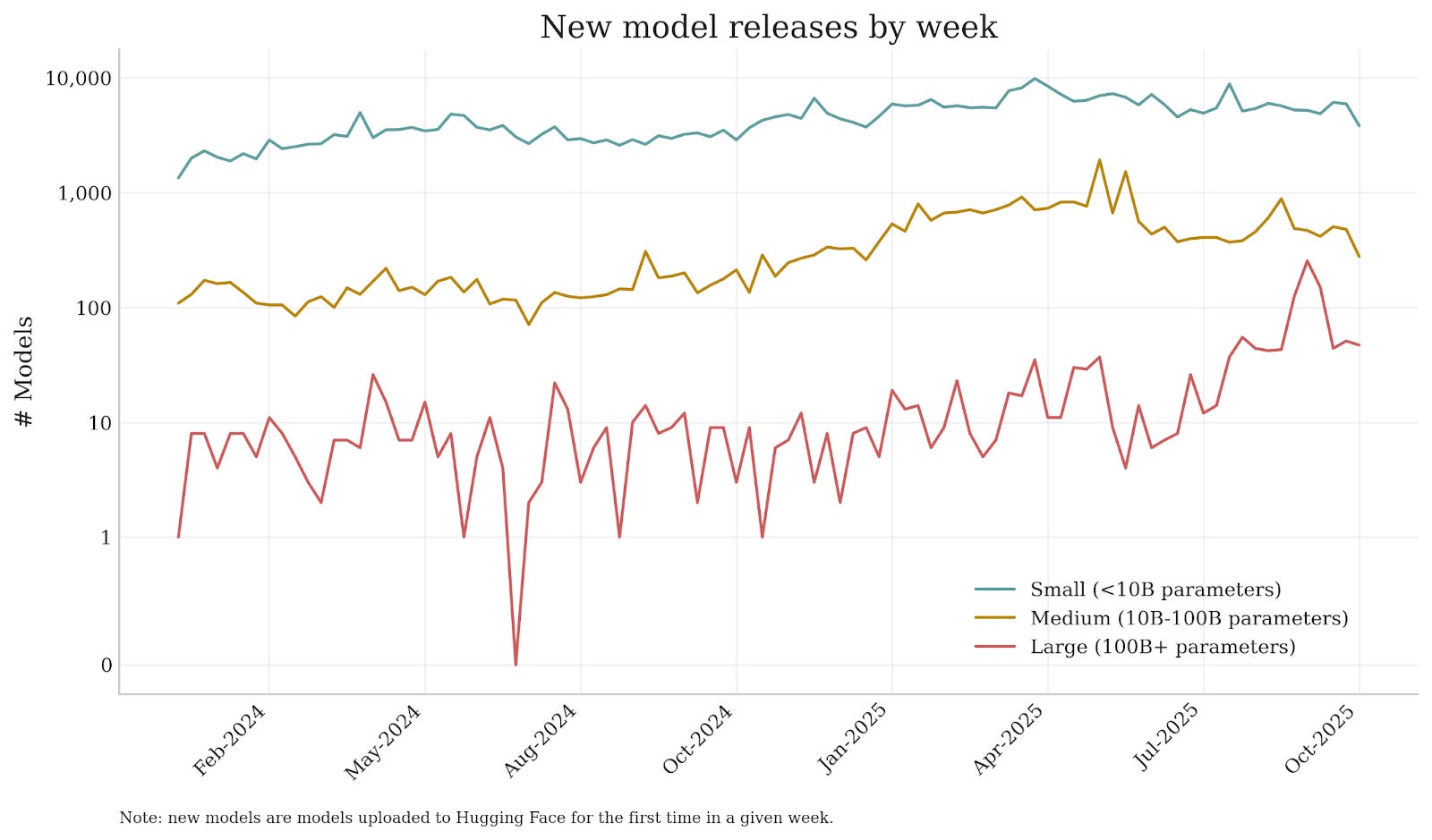
Every month, tens of thousands of AI models are created by frontier labs, scientists, and hobbyists. Some of these model releases become major public news events. In the days after a new model arrives online, timelines fill with demos, hot takes, and confident predictions about “what this means” for our jobs, the arts, and the economy in general. Developers rush to test, commentators extrapolate from early benchmarks, and policymakers scan for signals of acceleration or risk. But what actually happens after the headlines fade? How quickly do new capabilities translate into real adoption, automation, and economic impact, and for whom?
We recently had the chance to tackle such questions during our workshop on the Economics of AI and Automation. The workshop brought together economists studying what new models reveal about the pace of automation and economic change. Discussion throughout the day examined how firms test and adopt new AI capabilities, how financial markets react to model releases, and how these pieces of information shape our expectations for AI-induced growth and risk. In this post, we’ll distill a few points from those discussions:
Demand for new models rarely comes from cross-creator substitution (for example: when Anthropic releases Claude Opus 4.5, demand mostly isn’t drawn from existing Gemini users);
Firm automation decisions are driven by the outsized fixed costs of AI;
Financial markets are not predicting imminent transformative AI.
Demand for new models rarely comes from cross-creator substitution
Andrey Fradkin and his coauthors show that markets for language models are dynamic and competitive, with leading models dominating for a few months before being displaced. However, substitution patterns vary across providers and fall into two main types: some models cannibalize incumbents from the same creator, while others expand overall demand. Using data on model downloads and prices on OpenRouter, a platform for AI models, he shows that the release of Claude Sonnet 3.7 (for example) shifted demand sharply away from Claude Sonnet 3.5, an instance of within-creator substitution. But there was little to no contemporaneous decline in demand for competing models from other creators. Other releases, such as Gemini 2.5 Pro and xAI’s Grok Code Fast 1, show rapid adoption with minimal displacement of other models. This might suggest that these models increased aggregate demand, rather than reallocating existing demand.
It surprised us to see older models often retain users when newer models come out, even though OpenRouter makes it very seamless to swap models. Perhaps this is an indication that experimentation is expensive, making switching costs larger than they might appear at first glance; or that users have built their applications around a particular model that make switching difficult. Or it could simply be evidence of differentiation in the market for language models.
Firm automation decisions are driven by the outsized fixed costs of AI
Three papers throughout the workshop tackled the role of fixed costs in the development and impact of AI models. Rebekah Dix and coauthors show that cloud computing technology can turn what was traditionally a high fixed cost into a variable cost. Still, high fixed costs to procure computing infrastructure are still essential for understanding the economics of AI adoption: an MIT FutureTech paper (presented by Danial Lashkari and written with fellow FutureTech members Wensu Li, Neil Thompson and Christina Qiu) argues that fixed costs in many areas slow the pace of automation and shape its resultant impact on the economy. In a third presentation, Flavio Calvino and Luca Fontanelli confirm that many firms still find it worthwhile to pay the fixed cost of AI development.
In most technology-intensive industries, firms must pay some sort of fixed cost to get started. For example, a bank aiming to replace its customer service representatives with an AI chatbot must first fine-tune a model on its private data, and procure some quantity of computing infrastructure to serve the chatbot – both fixed costs that the firm pays up-front. Because firms can only imperfectly predict the future, these up-front investments can generate inefficiencies. If more customers than anticipated use the chatbot, the firm might have difficulty serving the chatbot to all of them with its stock of computing infrastructure. Dix et al. show how on-demand cloud computing providers like AWS solve this problem for the bank. Using cloud computing, it can quickly scale up and down its compute stock to adjust to varying demand. In other words, cloud computing turns a fixed cost into a variable cost.
But, as Lashkari and coauthors discuss, AI adoption still involves a number steps that incur significant fixed costs. Returning to our example, if only a few customers use a bank’s chatbot, it may not be worth it for the bank to pay the fixed costs of the fine-tuning process for so little return. The widespread presence of fixed costs such as thislike this one affects which tasks are worthwhile to automate. If a firm only needs to accomplish a few instances of a task, it might not be worthwhile to pay the up-front cost of investment in AI. This mechanism means that some tasks might not be automated even if frontier AI is more efficient than humans on a per-task basis.
Still, Calvino and Fontanelli show that many firms do adopt and develop AI despite its fixed cost. They demonstrate clear differences between firms that choose to purchase AI models from external developers (AI buyers), and those that choose to develop them in-house (AI developers). Using detailed survey data from French firms, they show that AI developers tend to be larger firms, but also newer. They also emphasize the role of complementary assets, showing that developers hold stock of IT assets. Speaking directly to the question of fixed costs, Flavio argues that the development of AI systems may involve higher fixed costs than purchasing but that firms which develop their AI tools in-house see a productivity boost from AI. The up-front cost might be high, but it pays off.
Markets are not predicting imminent transformative AI
Basil Halperin and co-authors argue that long-horizon real interest rates might provide a signal of AI progress. In standard economic models, any meaningful increase in the probability of transformative AI should raise long-term real interest rates by reducing the value of future consumption, regardless of whether AI yields explosive productivity growth or existential catastrophe. Why? The real interest rate is the cost of borrowing resources from the future to spend today. If transformative AI means we are either going to be enjoying the bounty of a plentiful world centered around aligned AI or we are heading to the abyss – either way – why wait to consume tomorrow? Carpe diem! Consume more today! In this framework, elevated long run rates would indicate markets pricing in a sharp break from historical growth paths, regardless of whether the anticipated outcome is overwhelmingly positive or negative. Of course, these assumptions assume that markets are informed and pricing risk efficiently.
Maryam Farboodi, an MIT FutureTech affiliate, along with her fellow MIT co-author Isaiah Andrews, provided convincing data that, as of September 2025, markets are not acting as though they expect transformative AI to be just around the corner. Studying bond markets around major AI model releases, she finds that long-dated yields consistently fall following announcements. This suggests that, conditional on new information from a release, markets revise beliefs away from transformation rather than toward it. Taken together, these results imply that markets are paying attention to AI progress, but the results also suggest that markets interpret recent releases as lowering growth expectations, (or, following Halperin et al., interpret them as evidence of a reduced likelihood of AI-induced catastrophe). Model announcements appear to shift expectations toward delayed or more modest impact — a conclusion that stands in contrast to the more dramatic narratives that often dominate in the immediate aftermath of a release.
Why might markets not be expecting higher growth from AI? One new idea came from Joshua Gans, who presented a framework examining how AI affects the direction of research. He models AI as an interpolation technology that fills gaps between existing areas of research. The key insight is that AI’s impact on growth depends on a critical threshold in its capabilities. When AI has modest interpolation range, connecting areas of research that already are “close together,” it encourages incremental research that increases the density of knowledge in an area of research, which – Gans argues – raises growth in a world where ideas are getting harder to find. But when AI becomes sufficiently capable, it might promote exploratory research that connects far-apart research areas, reducing knowledge density, paradoxically slowing growth in the long-run despite productivity gains in the short-run.
Concluding
The workshop itself was a great success, and we are grateful to all the presenters and participants who contributed to such a rich set of discussions. A fascinating set of seven talks by Rebekah Dix, Flavio Calvino, Maryam Farboodi, Andrey Fradkin, Basil Halperin, Joshua Gans and Danial Lashkari highlighted how much progress has been made in understanding AI adoption from both macro and micro perspectives, and also how much remains an open question.
Building on this momentum, MIT FutureTech has more research in the pipeline on related topics. For instance, an upcoming paper, “The Birth, Life, and Death of Models”, describes what happens when a model is released, how it is used throughout its “life”, and how it eventually fades away from economic relevance. That is not all for this academic year: we will be hosting another round of our Economics of AI and Automation workshop in the spring, continuing the conversation as both the technology and the evidence evolve.
Joseph Emmens, Kazimier Smith, Zach Brown, and Won-Jae Chang wrote this post. Aaron Kaye, Alex Fogelson, Sebastian Sartor, Zach Brown, and Neil Thompson provided editorial support. Lucy Yan provided logistical support.
 | A guest post by
|
 | A guest post by
|
 |
|
 | A guest post by
|
AI’s Big Gamble to build Data Centers!